
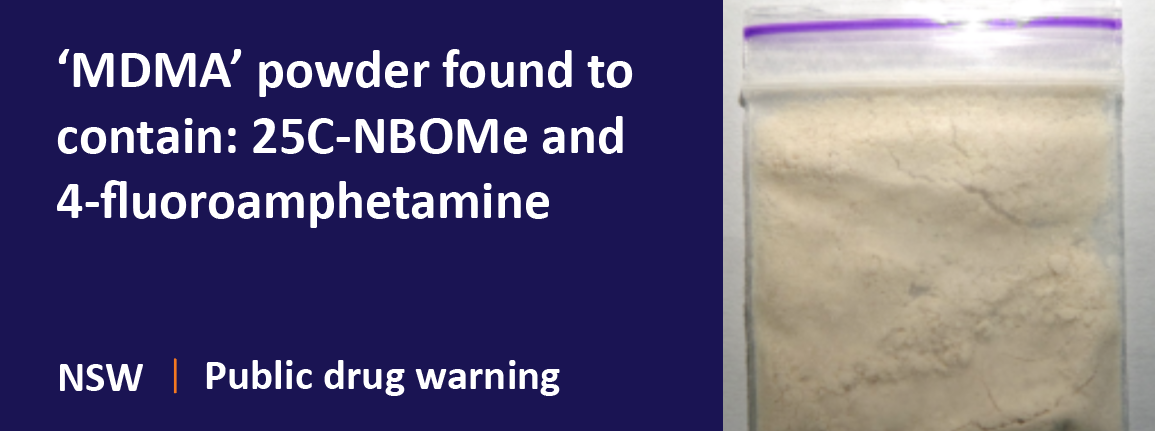
NSW - Public drug warning: ‘MDMA (ecstasy)' powder found to contain: 25C-NBOMe (a hallucinogen) and 4-fluoroamphetamine
Published on 1 December 2022
Source: https://www.health.nsw.gov.au/aod/public-drug-alerts/Pages/mdma-containing-nbome-fa.aspx
Emergency: If you are experiencing an emergency, please call an ambulance on 000, or if you need to speak to someone urgently please call the National Alcohol and Other Drug Hotline on 1800 250 015.
‘MDMA (ecstasy)' powder found to contain: 25C-NBOMe (a hallucinogen) and 4-fluoroamphetamine
Warning
25C-NBOMe is a potent hallucinogenic drug, and was misrepresented as light brown MDMA (Ecstasy) powder in Sydney. There have been several hospitalisations in June 2021.
Know the risks

- The NBOMe drugs can cause vivid hallucinations, violence, fear and agitation, the combination of which can lead to accidents, harm to self and others. These drugs are potent and can be life threatening.
- 4-fluoroamphetamine causes similar effects to MDMA and amphetamine.
- You are at increased risk of harm:
- If you use drugs alone
- As your dose increases
- If you use with other substances that cause hallucinations e.g. LSD, ketamine; or stimulants e.g. MDMA, cocaine or methamphetamine.
- The current cluster in NSW appears to be a light brown powder misrepresented as MDMA. NBOMe drugs are usually found in the form of blotting paper, liquid and tablets. They can also be misrepresented as LSD.
Effects to look out for
Serious adverse effects may include violent behaviour, vivid hallucinations, fever, agitation, derealisation and depersonalisation.
Getting help
If you see the warning signs of unexpected drug reactions:
- Seek help immediately from your nearest emergency department or call Triple Zero (000)
- Start CPR if someone is not breathing.
Support and advice
For free and confidential advice:
- Call Alcohol and Drug Information Service (ADIS) on 1800 250 015 at any time 24/7. Start a Web Chat with an ADIS counsellor Mon-Fri, 8.30am-5pm.
- Call NUAA on 1800 644 413 (Mon-Fri 9am-5pm) to speak to a peer or visit www.nuaa.org.au for a range of resources.
- Call the NSW Poisons Information Centre on 13 11 26 for information on adverse effects from drugs.
- Visit Your Room for fact sheets and other resources.
Take Home Naloxone program
- It is becoming more common for substances to be contaminated with opioids. Signs include loss of consciousness, slow/difficult breathing, skin turning blue. Anyone who uses drugs can get naloxone, which reverses opioid overdose.
- Naloxone is free, for participating locations
- Call '000' even if naloxone has been administered.
Current as at: Friday 2 July 2021